
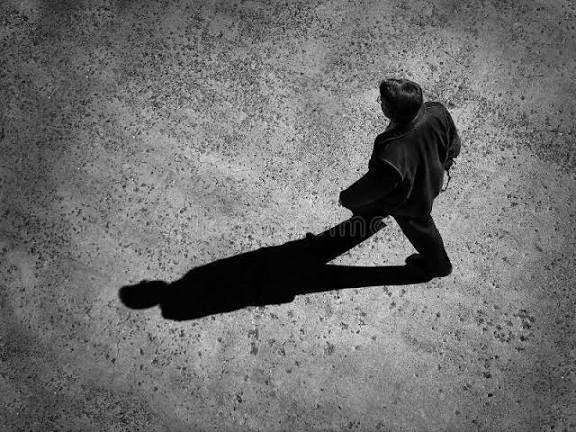
“Shadow work is the path of the heart warrior.“
Carl Jung
Carl Jung was a prodigy of Sigmund Freud, who first identified the notion of the unconscious mind as a part of the human psyche containing repressed, often primitive, emotions, and desires. Jung was a deeply introspective psychoanalyst whose ideas conflicted with Freud’s, leading to a rupture in their relationship. The occurrence of this, in combination with the onset of the First World War, sent Jung into a deep depression which ultimately led to him entering into a dark period in his life. During this time Jung experienced what he described as “the confrontation with the unconscious”. Jung subsequently spent many hours alone in deep self-analysis, recording his thoughts, dreams, and creating artwork.
This became a pivotal time in Jung’s life. He developed key theories, including the concept of human archetypes, which relates to a certain pattern of behaviour that we attribute to different types of people, to help us quickly work them out on a surface level. Once we believe that we have identified a person’s specific archetype identity, we tend to expect that we are able to predict their behaviour, but there is often a much more complex and multifaceted human being lurking underneath.
Jung theorised that in order to thrive as a human being, a person must stop trying to be who people think they should be, or what society expects them to be, and instead, become who they really are. He warned of the dangers of conforming to societal expectations, believing that it leads to an inauthentic life and kills individual potential. He went on to describe social conformity as the “graveyard of genius”. Promoting individuality became a core driving force of Jung’s work, a process which he defined as: individuation.
Jung noticed that people often hide parts of their personality which are deemed socially unnaceptable to subscribe to a particular archetypal figure. This denial of the self is influenced by cultural and societal norms. He described this repressed facet of personality as “the shadow”. The part of us that we fail to see or know. Jung believed that if we did not accept and integrate our shadow selves, we would either internalise this huge energy force as mental illness, or externalise it as harm towards others.
Everyone carries a shadow. The less it is brought into conscious awareness, the stronger it becomes, and therefore the more it will direct a person’s life decisions.
We can learn a great deal about our own shadow self by paying close attention to the elements of behaviour that irritate us or attract us to others, which can lead us to a deeper understanding of ourselves. We often project our unaccepted characteristics onto others, judging them or feeling drawn to them because of repressed parts which we are blind to within our own personality. Until the shadow self is adequately integrated, a person is likely to unconsciously make choices within their personal relationships based upon it, and enter into conflict with people who act in accordance with their own unrealised personality traits.
The shadow element of human nature can manifest on an individual basis, but it is also evident within institutions, professions, groups, collectives, political parties, religions, and countries. A group of people who are obsessed with worshipping the light side of human nature, whilst disavowing the dark, are likely to accumulate a shadow that may manifest as war, abuse, intolerance of human diversity, or political unrest.
We have a tendency to single out certain people as bearing responsiblity for the disharmony within our world. But the truth is that these individuals merely represent the shadow of the collective, they are figureheads for the whole. Any move towards healing our fractured world should really begin with individuals turning inwards to accept, own, and integrate their own shadow self. This is as important for the individual, as it is for our collective humanity.
WHAT IS THE AIM OF SHADOW WORK?
From a young age, we have often been taught to be good upstanding citizens and only show our “well behaved” side. This is necessary to a certain extent to maintain a safe and functioning society, but to become whole and vital, we have to stop pretending that our dark parts don’t exist. The aim of shadow work is to integrate these disavowed parts, without judgement. It is a continuous process, rather than an absolute goal.
The lesser-known element of shadow work involves what Jung called “the gold in the shadow”. Many people find it easier to access their dark parts than they do their light. These are the vital aspects of personality, which have often been repressed because they are not deemed conducive to societal stereotypes or archetypal identities. They are often believed to be “too different” or, “too much”.
Once you have an understanding of your shadow parts, you have the option of either becoming them more consciously, or trying to change them. Our personality is basically a construct: it’s a house that we have built to survive the world. If you fully understand who you are and why you ended up this way, you can try to change yourself if you wish. You may benefit from making changes in your external world or learning skills to emotionally regulate; a person’s worst parts often come out when they are under stress. Understanding your triggers, and trying to mitigate them within your environment can help.
SHADOW WORK AT HOME
You may like to try keeping a shadow journal. Freeflow all of your thoughts out in a stream of consciousness manner, without any censorship or judgement.
Try connecting with your inner child before doing this…. start by closing your eyes and visualising yourself now, with yourself as a young child. Choose a specific age and picture yourself clearly. Make a commitment to your inner child that they are safe, loved unconditionally, and that you will protect them. Give them permission to speak freely without judgement.
You may like to journal on some of these questions…
SHADOW WORK WITHIN THERAPY
Shadow work within therapy really involves entering into a process of rigorous honesty with your therapist. This sounds easy, but in reality: it’s not. Shadow and shame are inextricably linked, and shadow work is often inhibited by shame. The shadow tends to emerge over time, when it’s ready – rushing the process can be incredibly confusing, and result in overwhelm. We genuinely do not know who we are underneath our carefully constructed personalities, masks, and personas that we have been developing since childhood. Disidentifying too quickly from our perceived sense of self has the potential to be psychologically shattering. Developing a strong and supportive relationship with your therapist, in which you feel safe and not judged, is key.
Sometimes in therapy, and in life, all that is necessary for a person’s feeling to be alleviated and integrated, is to say it out loud in front of a non-judgemental witness. Sometimes all that is needed is a human mirror. Any shame a person may be feeling about themselves is likely to be alleviated, and as such they will become more mentally light. The goal is not to fix yourself, but more to understand yourself fully. To do this, you need to just be honest.
The outcomes of shadow work that I have seen in clients are often enormous personality transformations that are humbling to witness. From my experience, this tends to happen over a long period of time in therapy, normally years. Clients often describe having “breakthroughs”, when they realise something about themselves that they didn’t know before. Their initial goal is often driven by societal norms or their inner critic, or a desire to remove an uncomfortable coping mechanism, like anxiety. Their anxiety may be driven by the huge amount of energy that they are investing into repressing their authenticity, or the shame that they feel about being different.
FINAL THOUGHTS…….
A question I sometimes ask clients as they enter into therapy is this….. “Do you want to disrupt the status quo in your life?” The truth is that embarking on shadow work may change a person in a way that is impossible to predict, or control from the outset, and the real question is….. “Do you want that?”
Shadow work is ultimately about authenticity, vulnerability, and taking off our masks. Speaking from the heart about who we really are, light and dark, as opposed to attacking others.
This work is not for the fainthearted, and it’s also not something that you can tick off a list in terms of your personal development. It is representative of a huge and vital energy force, made up of the fragmented and denied parts of ourselves. Integrating these parts to create a fully functioning whole can be both terrifying and transformative, but it can also set us free.